
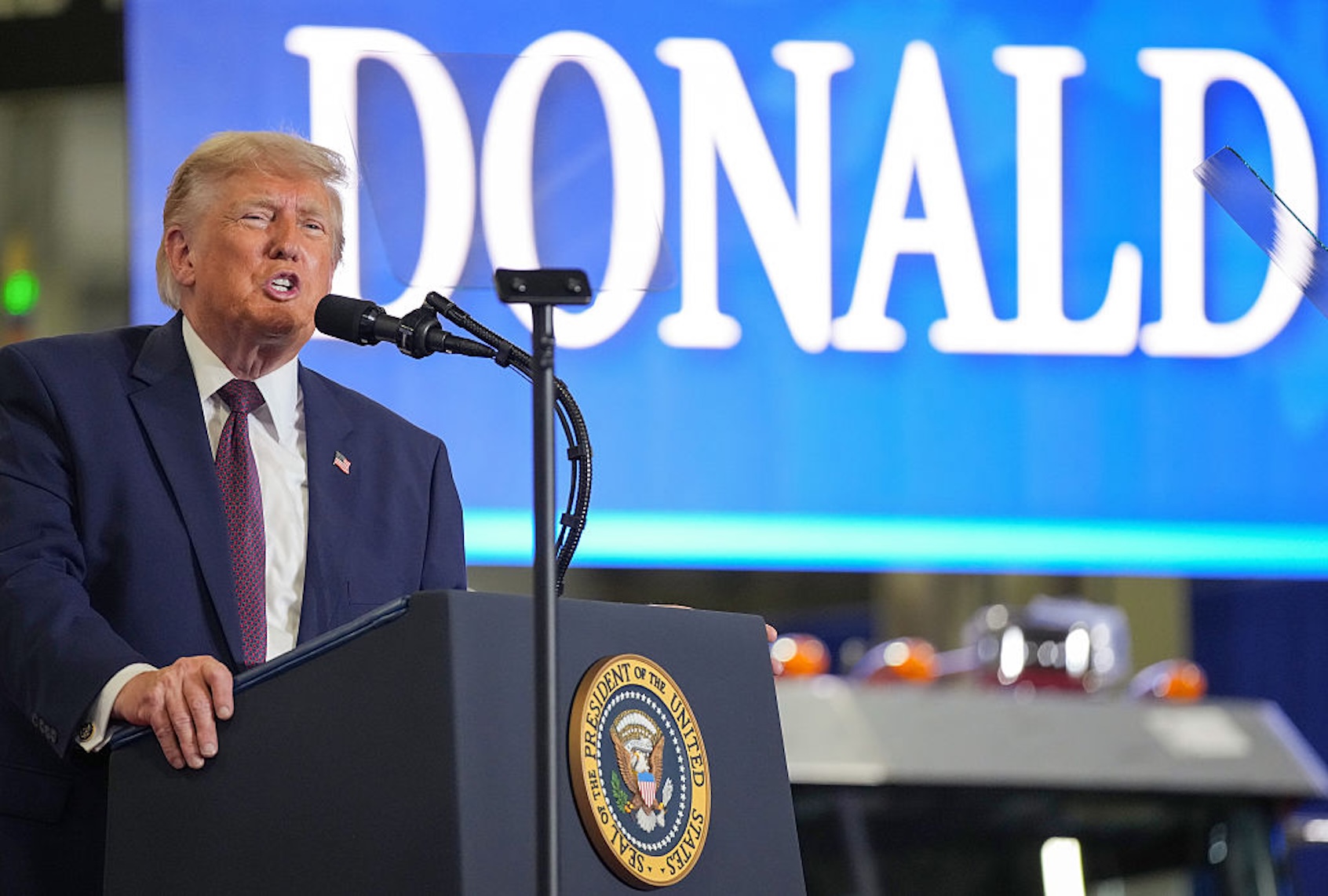
As they head into the final stretch of the midterms, Republicans have maintained a significant fundraising advantage buoyed, in large part, by hundreds of millions in super PAC cash. The question is whether this will be enough to overcome the fundraising advantages of key Democratic candidates, and whether President Donald Trump will dip into his own super PAC’s $400 million war chest to help his party.
Read more Millionaires could dominate Texas’ crop of new Congress members
In the latest FEC filings, a pattern has emerged: Democratic candidates in key Senate races are outraising their opponents, even as the Democratic Party’s campaign arms are struggling to keep pace with their Republican counterparts.
The top fundraisers so far this cycle have been almost exclusively Democratic Senate candidates, with Sen. Jon Ossoff, D-Ga., leading the money race, having raised nearly $98 million for his closely watched reelection bid. Ossoff is followed by Texas Democratic Senate nominee James Talarico with $69 million, former Ohio Sen. Sherrod Brown with $39 million; North Carolina Gov. Roy Cooper with $35 million and New Jersey Sen. Cory Booker with $34 million.
The top-raising Senate Republican was South Carolina Sen. Lindsey Graham, with $22 million, before his death earlier this month. Now, the leader is Maine Sen. Susan Collins, who has banked a $19 million war chest.
On the House side, Rep. Alexandria Ocasio-Cortez, D-N.Y., was the standout fundraiser with $33 million in her campaign account. Other top fundraisers are mostly House leaders like Speaker Mike Johnson, R-La., and Minority Leader Hakeem Jeffries, D-N.Y.
All told, Democratic Senate candidates have collectively raised $574 million to Republicans’ $336 million, while Democratic House candidates have raised $1 billion to the GOP’s $800 million.
The complicating factor, however, is the Republicans’ significant lead in the realm of super PAC fundraising. The two principal GOP PACs have raised $478 million between them, with the Senate Leadership Fund raising $254 million and the National Republican Congressional Committee raising $200 million. Their Democratic counterparts have a combined total of $338 million: $140 million by the Democratic Senatorial Campaign Committee and $198 million by the Democratic Congressional Campaign Committee.
In the most competitive House races, GOP candidates have edged out a money advantage over Democrats.
According to Brendan Glavin, the director of insights at the campaign finance watchdog OpenSecrets, the picture is even more complicated for Democrats. In the most competitive House races, GOP candidates have edged out a money advantage over Democrats. Significant portions of the money candidates have raised has also already been spent on primary elections, meaning that much of the funds are already spent or may not be available for general election spending.
“[The Democratic] advantage is essentially completely wiped out by their deficiencies on the party level, the outside group level, and with the party committees and the super PACs,” Glavin said. “Look at the four super PACs that are controlled by the party leadership, and these are the most important in any congressional elections. There’s a massive advantage for the Republicans there.”
Following the recent Supreme Court decision that allowed them to spend unlimited amounts in political races, the actual national party committees — the Republican National Committee and the Democratic National Committee — are also newly relevant in campaigns. On this front, Democrats are deep in the hole, with the DNC having raised some $207 million this cycle and having already spent roughly $213 million. Meanwhile, the RNC has raised around $278 million while managing to spend far less — $188 million.
Read more How owning books became everybody’s business
But the big “wild card,” as Glavin puts it, is Trump’s super PAC MAGA INC., which maintains a $400 million war chest. No one knows if, or how, that money will be spent.
For months, Republicans have been pleading with Trump to spend some of this money to help their midterm efforts, and so far the PAC has spent only a tiny sliver of the total, and only on consulting fees, banking fees and other minor expenses for the organization.
Instead of being used for congressional races, campaign finance analysts like Glavin have speculated that it could be spent at Trump-friendly or Trump-associated consulting firms. The logic behind this is that politicians cannot legally pocket campaign funds, though they are allowed to spend money at firms they or their family members hold a stake in, which could then, in turn, pay people for their campaign strategy or advertising services.
There is still, however, a glimmer of hope for Democrats in the money race, which comes down partially to something known as the preferential rate. Legally, broadcasters are required to give candidates the lowest unit prices when they buy ad time on broadcast channels, meaning that a candidate’s money goes further than a super PAC’s or party committee’s.
Michael Franz, a director at the Wesleyan Media Project, which studies political media, told Salon that this law has more of an impact in the final days of a campaign, when the difference between the lowest unit price and the premium prices paid by super PACs is typically the largest.
“Super PACs are going to pay through the nose in these competitive markets,” he said, “because if they want to get on ‘Jeopardy’ in Indianapolis or Columbus, Ohio, on the Wednesday before election day, the TV station that sells in the ad space would be happy to sell them the space for $10,000, and they’ll pay.”
Franz said that while there are no standard rules of thumb as to how much candidate campaign cash is worth compared to super PAC cash, there’s no doubt that campaigns tend to be more efficient.
“The ratio might be astronomical in certain places at certain times of the campaign, and that’s a really inefficient use of money if you’re the super PAC,” he said. “So a super PAC might have $100 million, but it may go just as far as a candidate who has $20 million in terms of its reach and how much information it actually sends out to voters.”
Franz also noted that, alongside issues of candidate versus PAC spending, there is also a point of diminishing returns with advertising spending, though where exactly this point is varies and is hard to quantify. Campaigns have also, in his assessment, a healthy variety of ads, meaning that many voters will simply be exposed to the same messages over and over again, which Franz said is likely less effective than the same spending would be with a greater variety of ads.
Read more Netflix is turning your brain to mush